# 32.9.2 LINE SPRING ELEMENT LIBRARY
# Product: Abaqus/Standard
# References
• “Line spring elements for modeling part-through cracks in shells,” Section 32.9.1
• \*SHELL SECTION
• \*SURFACE FLAW
# Overview
This section provides a reference to the line spring elements available in Abaqus/Standard.
# Element types
LS6 6-node general second-order line spring
LS3S 3-node second-order line spring for use on a symmetry plane
Active degrees of freedom
1, 2, 3, 4, 5, 6
Additional solution variables
None.
# Nodal coordinates required
X, Y, Z required at each node and, optionally, $N _ { x } , N _ { y } , N _ { z }$ (direction cosines of the normal to the shell) at each node.
A user-defined normal definition (see “Normal definitions at nodes,” Section 2.1.4) can also be used to specify $N _ { x } , N _ { y } , N _ { z }$ . If these are not specified, they are constructed as for all other shell elements—by averaging over the shell elements attached to each node.
# Element property definition
The only element property used is the thickness; the number of integration points is ignored, since the elements work on the basis of section properties.
Input File Usage: Use the following option to define line spring element properties:
\*SHELL SECTION
Use the following option to define the depth of the crack as a function of position:
\*SURFACE FLAW
# Distributed loads
Distributed loads are specified as described in “Distributed loads,” Section 34.4.3.
Three Gauss points are used for crack face pressure loading.
| Load ID (*DLOAD) | Units | Description |
| HP | $FL^{-2}$ | Hydrostatic surface pressure on the crack faces, with magnitude varying linearly with the global Z-direction. |
| P | $FL^{-2}$ | Surface pressure on the crack faces. |
# Element output
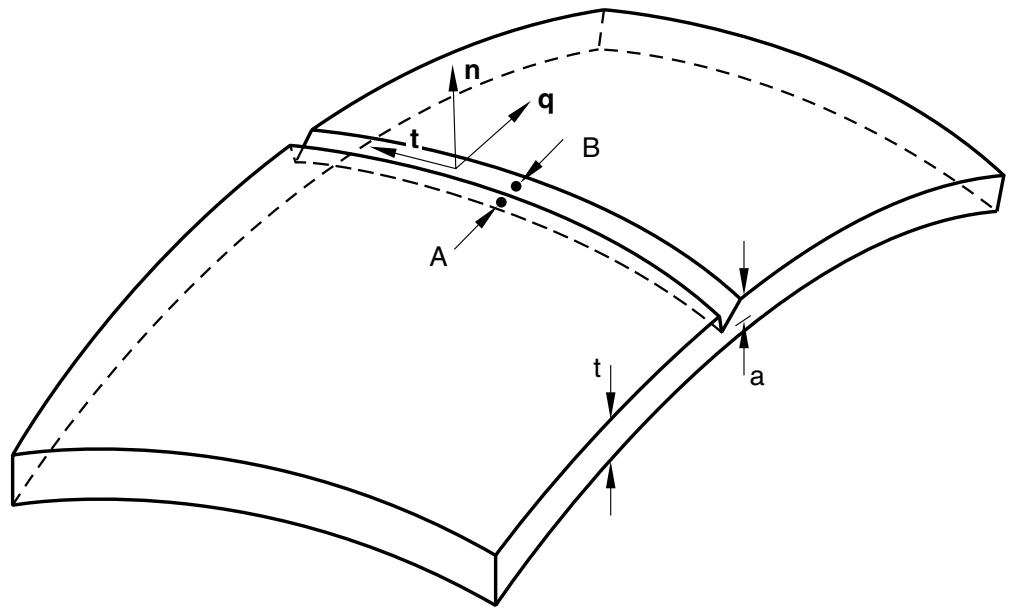
Nodes 1, 2, and 3 on the element define side B and nodes 4, 5, and 6 define side A (see Figure 32.9.2–1). The sign of the crack is defined by the surface of the shell from which the crack originates, which you identify when you define the depth of the crack (see “Line spring elements for modeling partthrough cracks in shells,” Section 32.9.1). If the crack originates from the positive surface of the shell, sign(crack)=1.0; if the crack originates from the negative surface of the shell, sign(crack)=−1.0.
The vector is defined by the right-hand rule from the cross product of the tangent, , which is positive going from node 1 to node 3 of the element, and the normal, , defined when the coordinates are given (or by a user-defined normal definition). For element type LS3S the vector must point into the model (away from the symmetry plane). For element type LS6 the vector must point from side A to side B.
# “Strains”
| E11 | Mode I opening displacement, $(u_{B} - u_{A}) \cdot \mathbf{q}$ |
| E22 | Mode I opening rotation, $(\phi_{B} - \phi_{A}) \cdot \mathbf{t} \times \text{sign}(\text{crack})$ |
The following strains exist only for LS6:
| E33 | Mode II through thickness shear, $(\mathbf{u}_B - \mathbf{u}_A) \cdot \mathbf{n}$ |
| E12 | Mode II rotation, $(\phi_B - \phi_A) \cdot \mathbf{n}$ (this strain plays no role) |
| E13 | Mode III antiplane shear, $(\mathbf{u}_B - \mathbf{u}_A) \cdot \mathbf{t} \times \text{sign}(\text{crack})$ |
| E23 | Mode III opening rotation, $(\phi_B - \phi_A) \cdot \mathbf{q}$ |
The conjugate forces and moments are available by requesting “stress” output.
The J-integral is provided at each integration point. If elastic-plastic material behavior is defined, the elastic and plastic parts of J are provided. The stress intensity factors, K, are also provided corresponding to the elastic parts of J.
text_image
n
q
B
A
t
a
Figure 32.9.2–1 Notation for line spring strains.
# Nodes associated with the element

text_image
LS6
4
1
t
5
q
side A
2
side B
6
3
LS3S
t
2
q
side B
1
3
32.9.2–3
Three points (these points are at the nodes) are used for integration and element output.

flowchart
Diagram showing two curved paths labeled LS6 and LS3S, each with numbered points and directional arrows indicating flow or movement.
# 32.10 Elastic-plastic joints
• “Elastic-plastic joints,” Section 32.10.1
• “Elastic-plastic joint element library,” Section 32.10.2
# 32.10.1 ELASTIC-PLASTIC JOINTS
Product: Abaqus/Aqua
# References
• \*EPJOINT
• “Elastic-plastic joint element library,” Section 32.10.2
# Overview
JOINT2D and JOINT3D elements:
• are available for use only in Abaqus/Aqua used in conjunction with Abaqus/Standard (“Abaqus/Aqua analysis,” Section 6.11.1);
• can be used to model flexible joints between structural members or the interaction between spud cans and the ocean floor;
• are valid for small displacements and rotations; and
• can be purely elastic or elastic-plastic.
# Elastic-plastic joint elements
Abaqus/Standard provides JOINT2D and JOINT3D elements for modeling a joint between structural members or between a structural member and a fixed support. They can be used in an Abaqus/Aqua analysis to model the interaction between a “spud can” and the sea floor for jack-up foundation analysis in offshore applications.
The joint has two nodes. One of these nodes should be constrained fully (by using a boundary condition) if the joint is between a structural member and a fixed support.
# Kinematics and local coordinate system
The deformation of the joint is characterized by joint “strains,” which are relative displacements and rotations between the nodes of the joint. The joint must be associated with a user-defined local orientation system (see “Orientations,” Section 2.2.5) that is defined by three orthonormal directions: $\mathbf { e } _ { 1 } , \mathbf { e } _ { 2 } ,$ , and .
The joint, when strained by relative extension or rotation of the two nodes, responds by applying equal and opposite forces and/or moments to the nodes. These forces and moments, or joint “stresses,” can be a linear (elastic) or nonlinear (elastic-plastic) function of the “strains,” depending on the type of constitutive model used in the joint.
The stresses and strains are named as shown in Figure 32.10.1–1. Positive stress indicates tension; positive strain indicates extension.

text_image
joint between
structural
members
1
2
3
1
2
D₀
D
θ
2
1
vₘ
v꜀
joint as a spud can
joint "stresses":
forces and moments
shown on node 2
Figure 32.10.1–1 Local axis definition for joint elements.
Even when geometrically nonlinear analysis is requested (“Geometric nonlinearity” in “General and linear perturbation procedures,” Section 6.1.3), the element kinematics are defined with the assumption of small relative displacements and small rotations; therefore, these elements should not be used when these assumptions are violated. If large rotations are required and there is no plasticity, JOINTC elements can be used (see “Flexible joint element,” Section 32.3.1).
The “extensional” strains are defined through
$$
\varepsilon_ {i i} = \Delta \mathbf {u} \cdot \mathbf {e} _ {i} \quad \text {(no summation)},
$$
and the “bending” strains through
$$
\varepsilon_ {i j} = \Delta \boldsymbol {\phi} \cdot \mathbf {e} _ {k}, \quad \text {(where i < j and k\neq i,j),}
$$
where
$$
\Delta \mathbf {u} = \mathbf {u} ^ {2} - \mathbf {u} ^ {1}, \quad \Delta \phi = \phi^ {2} - \phi^ {1}
$$
are the relative displacements and rotations of the two nodes of the joint, respectively.
For two-dimensional elements only the axial strains $\varepsilon _ { 1 1 } , \varepsilon _ { 2 2 }$ , and the bending strain $\varepsilon _ { 1 2 }$ exist. For three-dimensional elements all six components exist.
# Input File Usage:
Use the following option to associate a local orientation system with an elasticplastic joint element:
\*EPJOINT, ORIENTATION=name
# Joint constitutive models
The elastic moduli for joint elasticity can be entered in one of two ways. You can specify a general, anisotropic relation between the forces/moments and elastic extensions. Alternatively, you can enter moduli specific for a spud can; the elastic stiffness matrix is diagonal and depends on the diameter of the spud can at the soil surface, D, which can vary if spud can plasticity is defined and the spud can is conical. See “Joint elasticity models” below for details.
Three joint plasticity models are provided. Two are specific to spud cans. The third is a parabolic model for structural joints or members. See “Joint plasticity” below for details.
If plasticity is included, the plastic straining is assumed to occur in the local 1–2 plane so that the only nonzero plastic strains are $\varepsilon _ { 1 1 } ^ { \bar { p } l } , \varepsilon _ { 2 2 } ^ { p l }$ , and $\varepsilon _ { 1 2 } ^ { p l }$ . It is assumed that plasticity in the 3-direction can be neglected. In a three-dimensional model strains out of the 1–2 plane produce purely elastic response.
If the parabolic plasticity model for structural joints or members is used, the 1-direction is the axial direction along the members, while the 2-direction is the transverse direction (see Figure 32.10.1–1). In the spud can plasticity models the 1-direction is the vertical direction, and the 2-direction is the horizontal direction in which plastic extension can take place. In three-dimensional models the 3-direction is the horizontal direction in which only elastic extension can take place.
Any combination of elastic and plastic models can be used. For example, usually spud can elastic moduli will be used with spud can plasticity, but the use of general moduli with spud can plasticity is allowed.
If plasticity is used in a three-dimensional model, coupling is not allowed through the elastic modulus between the strains or stresses in the 1–2 plane $( \varepsilon _ { 1 1 } , \varepsilon _ { 2 2 } , \varepsilon _ { 1 2 } )$ and the remaining, out-of-plane, strains $( \varepsilon _ { 3 3 } , \varepsilon _ { 1 3 } , \varepsilon _ { 2 3 } )$ . Thus, in this case many of the general elastic moduli must be set to zero.
# Input File Usage:
Use one or both of the following options immediately after the related \*EPJOINT option to define the joint constitutive model:
\*JOINT ELASTICITY
\*JOINT PLASTICITY
# Orientation
Care must be taken in defining the local directions and node numbering so that the motion of node 2 relative to node 1 in the positive 1-direction of the local axis corresponds to extension. Incorrect specification of the local directions or element node numbering can produce incorrect results in plastic analysis because compression will be interpreted as extension.
If one of the nodes must be fixed to represent the ground, it is most convenient to let this node be the first node of the element; extension is then represented by the motion of node 2 of the element in the positive local 1-direction. If a spud can is being modeled in this way, the local 1-direction should be the outward normal to the ocean floor. For a two-dimensional analysis that uses Abaqus/Aqua structural loads, this direction must be the global y-direction.
For a three-dimensional analysis that uses Abaqus/Aqua structural loads, the local 1-direction should point in the global z-direction. If plasticity is being used, the local 2-direction should be set so that the 1–2 plane is the plane of greatest deformation.
Input File Usage: Use the following orientation definition to model a spud can with the first node fixed:
*ORIENTATION, NAME=name, TYPE=RECTANGULAR
0, 1, 0, -1, 0, 0
Use the following orientation definition for a three-dimensional Abaqus/Aqua analysis with plasticity:
*ORIENTATION, NAME=name, TYPE=RECTANGULAR
0, 0, 1, x, y, 0
where (x, y, 0) defines the local 2-direction.
# Spud can geometry
If either spud can elasticity or spud can plasticity is used, you must specify the constants to define the spud can geometry. The entire spud can section definition has no effect if there is neither spud can elasticity nor spud can plasticity.
The spud can, illustrated in Figure 32.10.1–1, can be either conical-based or flat-based. The spud can geometry is defined by $D _ { o }$ , the diameter of the cylindrical portion, and , the planar angle of the conical portion, where $0 < \theta \leq 1 8 0 ^ { \circ }$ . You can specify a flat-based spud can by omitting the specification of or by giving a value of 0 or 180 for .
Input File Usage: *EPJOINT, SECTION=SPUD CAN $D_{o}, \theta$
# Spud can initial embedment
If spud can plasticity is defined or if there is spud can elasticity and the spud can is conical, you must specify the initial embedment of the spud can, $\nu _ { i } .$ .
The embedment can be prescribed directly or by specifying a “preload” that produces the embedment, as discussed below. Specification of both embedment and preload is not allowed. If either embedment or preload is given, both embedment and equivalent preload (in the case of plasticity) can be examined in the data file at the start of the analysis.
At any time in the analysis the spud can has a total (plastic) embedment of $\nu _ { m } = \nu _ { i } - \varepsilon _ { 1 1 } ^ { p l } ( t )$ , where $\varepsilon _ { 1 1 } ^ { p l } ( t )$ is the plastic embedment between the start of the analysis and time t. (The negative sign in this equation reflects the fact that the sign convention for strain in Abaqus is positive for tensile strain. Most often for spud can plasticity, $\varepsilon _ { 1 1 } ^ { p l } ( t )$ will be compressive, or negative.) The joint can be purely elastic, in which case $\varepsilon _ { 1 1 } ^ { p l } = 0 \mathrm { { : } }$ , so $\nu _ { m } = \nu _ { i }$ always.
The height of the conical portion of the spud can is given by $\nu _ { c } = D _ { o } / 2 \tan ( \theta / 2 )$ . The effective diameter of the spud can at the soil surface, D, is defined by