# Specified Temperatures In addition to convection and radiation boundary conditions, nodal point temperature conditions may also be specified. These boundary conditions can be incorporated in the same way as known nodal point displacements are prescribed in stress analysis. A common procedure is to substitute the known nodal point temperatures in the heat flow equilibrium equations (7.21) and (7.28) and delete the corresponding equations from those to be solved (see Section 4.2.2). However, an effective way to impose nodal point temperatures can be the procedure that is employed to impose convection boundary conditions. Namely, by assigning a very large value of convection coefficient h, where h is much larger than the conductivity of the material, the surface nodal point temperature will be equal to the prescribed environmental nodal point temperature. EXAMPLE 7.4: Establish the governing finite element equations for the analysis of the infinite parallel-sided slab shown in Fig. E7.2 but neglect the radiation effects. Use the modified Newton-Raphson solution and only one parabolic one-dimensional element to model the slab. (In practice, depending on the temperature gradient to be predicted by the analysis, many more elements may be needed.) The governing equations for this problem are obtained from (7.28), $$ \left(^ {t} \mathbf {K} ^ {k} + ^ {t} \mathbf {K} ^ {c}\right) \Delta \boldsymbol {\theta} ^ {(i)} = ^ {t + \Delta t} \mathbf {Q} + ^ {t + \Delta t} \mathbf {Q} ^ {c (i - 1)} - ^ {t + \Delta t} \mathbf {Q} ^ {k (i - 1)} \tag {a} $$ where $$ ^ {t} \mathbf {K} ^ {k} = \int_ {V} \mathbf {B} ^ {T} {} ^ {t} k \mathbf {B} d V $$ $$ ^ \prime \mathbf {K} ^ {c} = \int_ {S _ {c}} ^ {\prime} h \mathbf {H} ^ {S ^ {T}} \mathbf {H} ^ {S} d S $$ $$ { } ^ { t + \Delta t } \mathbf { Q } ^ { c ( i - 1 ) } = \int _ { S _ { c } } { } ^ { t + \Delta t } h ^ { ( i - 1 ) } \mathbf { H } ^ { S ^ { T } } \left[ \mathbf { H } ^ { S } ( { } ^ { t + \Delta t } \boldsymbol { \theta } _ { e } - { } ^ { t + \Delta t } \boldsymbol { \theta } ^ { ( i - 1 ) } ) \right] d S $$ $$ { } ^ { t + \Delta t } \mathbf { Q } ^ { k ( i - 1 ) } = \int _ { V } \mathbf { B } ^ { T } \left[ { } ^ { t + \Delta t } k ^ { ( i - 1 ) } \mathbf { B } ^ { t + \Delta t } \boldsymbol { \theta } ^ { ( i - 1 ) } \right] d V $$ $$ { } ^ { t + \Delta t } \mathbf { Q } ^ { T } = [ 0 \quad q ^ { S } \quad 0 ] $$ and $$ \Delta \boldsymbol {\theta} ^ {(i) ^ {T}} = \left[ \begin{array}{c c c} \Delta \theta_ {1} ^ {(i)} & \Delta \theta_ {2} ^ {(i)} & \Delta \theta_ {3} ^ {(i)} \end{array} \right] $$ $$ { } ^ { t + \Delta t } \boldsymbol { \theta } ^ { ( i - 1 ) ^ { T } } = \left[ \begin{array} { c c c } t + \Delta t \theta _ { 1 } ^ { ( i - 1 ) } & t + \Delta t \theta _ { 2 } ^ { ( i - 1 ) } & t + \Delta t \theta _ { 3 } ^ { ( i - 1 ) } \end{array} \right] $$ $$ ^ {t + \Delta t} \boldsymbol {\theta} _ {e} ^ {T} = [ 2 0 \quad 0 \quad 0 ] $$ For the one-dimensional parabolic element, we use the interpolation functions $h_{1}$ , $h_{2}$ , and $h_{3}$ in Fig. 5.3 to construct H, $$ \mathbf {H} = \left[ \frac {1}{2} r (1 + r) - \frac {1}{2} r (1 - r) (1 - r ^ {2}) \right] $$ and $H^{s}$ corresponding to node 1 is equal to H evaluated at $r = +1$ , $$ \mathbf {H} ^ {s} = \left[ \begin{array}{c c c} 1 & 0 & 0 \end{array} \right] $$ We also have $J = L / 2$ ; hence, $$ \mathbf {B} = \frac {2}{L} \left[ \frac {1}{2} (1 + 2 r) - \frac {1}{2} (1 - 2 r) - 2 r \right] $$ Also, the conductivity of the material is given by, for example, for time t, $$ ^ \prime k = 1 0 + 2 \sum_ {i = 1} ^ {3} h _ {i} ^ {\prime} \theta_ {i} $$ and similarly for the convection coefficient we have $$ \left. ^ {\prime} h \right| _ {r = + 1} = 2 + ^ {\prime} \theta_ {1} $$ With these quantities defined we can now evaluate all matrices in (a) and perform the temperature analysis. Note that we are using $S_{c} = 1$ and $V = 1 \times L$ . See Exercise 7.6 for the analysis including the radiation effects. # Transient Analysis As mentioned earlier, in transient heat transfer analysis the heat capacity effects are included in the analysis as part of the rate of heat generated. The equations considered in the solution depend, however, on whether implicit or explicit time integration is used, just as in structural analysis (see Chapter 9 and, for example, K. J. Bathe and M. R. Khoshgoftaar [A]). If the Euler backward implicit time integration is employed, the heat flow equilibrium equations used are obtained directly from the equations governing steady-state conditions [see (7.18)]. Namely, using for element m, $$ \dot {\boldsymbol {\theta}} ^ {(m)} (x, y, z, t) = \mathbf {H} ^ {(m)} (x, y, z) \dot {\boldsymbol {\theta}} (t) \tag {7.30} $$ and now using (7.12), we have in (7.28), $$ { } ^ { t + \Delta t } \mathbf { Q } _ { B } = \sum _ { m } \int _ { V ^ { ( m ) } } \mathbf { H } ^ { ( m ) T } ( { } ^ { t + \Delta t } q ^ { B ( m ) } - { } ^ { t + \Delta t } ( \rho c ) ^ { ( m ) } \mathbf { H } ^ { ( m ) } { } ^ { t + \Delta t } \dot { \mathbf { \theta } } ) d V ^ { ( m ) } \tag {7.31} $$ where $t+\Delta t q^{B(m)}$ no longer includes the rate at which heat is stored within the material. Hence, the finite element heat flow equilibrium equations considered in transient conditions are, in linear analysis, $$ \mathbf {C} ^ {t + \Delta t} \dot {\boldsymbol {\theta}} + (\mathbf {K} ^ {k} + \mathbf {K} ^ {c}) ^ {t + \Delta t} \boldsymbol {\theta} = ^ {t + \Delta t} \mathbf {Q} + ^ {t + \Delta t} \mathbf {Q} ^ {e} \tag {7.32} $$ and in nonlinear analysis (using the full Newton-Raphson iteration but without linearizing the heat capacity effect, see Section 9.6), $$ \begin{array}{l} { } ^ { t + \Delta t } \mathbf { C } ^ { ( i ) } { } ^ { t + \Delta t } \dot { \boldsymbol { \theta } } ^ { ( i ) } + \left( { } ^ { t + \Delta t } \mathbf { K } ^ { k ( i - 1 ) } + { } ^ { t + \Delta t } \mathbf { K } ^ { c ( i - 1 ) } + { } ^ { t + \Delta t } \mathbf { K } ^ { r ( i - 1 ) } \right) \Delta \boldsymbol { \theta } ^ { ( i ) } \tag {7.33} \\ = ^ {t + \Delta t} \mathbf {Q} + ^ {t + \Delta t} \mathbf {Q} ^ {c (i - 1)} + ^ {t + \Delta t} \mathbf {Q} ^ {r (i - 1)} - ^ {t + \Delta t} \mathbf {Q} ^ {k (i - 1)} \\ \end{array} $$ where $\mathbf{C},{}^{t + \Delta t}\mathbf{C}^{(i)}$ are the heat capacity matrices, $$ \mathbf {C} = \sum_ {m} \int_ {V ^ {(m)}} \mathbf {H} ^ {(m) ^ {T}} \rho c ^ {(m)} \mathbf {H} ^ {(m)} d V ^ {(m)} $$ $$ { } ^ { t + \Delta t } \mathbf { C } ^ { ( i ) } = \sum _ { m } \int _ { V ^ { ( m ) } } \mathbf { H } ^ { ( m ) ^ { T } } { } ^ { t + \Delta t } ( \rho c ) ^ { ( m ) ^ { ( i ) } } \mathbf { H } ^ { ( m ) } d V ^ { ( m ) } \tag {7.34} $$ The matrices defined in $(7.34)$ are consistent heat capacity matrices because the same element interpolations are employed for the temperatures as for the time derivatives of temperatures. Following the concepts of displacement analysis, it is also possible to use a lumped heat capacity matrix and lumped heat flow input vector, which are evaluated by simply lumping heat capacities and heat flow inputs, using appropriate contributory areas, to the element nodes (see Section 4.2.4). If, on the other hand, the Euler forward explicit time integration is used, the solution for the unknown temperatures at time $t + \Delta t$ is obtained by considering heat flow equilibrium at time t. Applying the relation in (7.7) at time t and substituting the finite element interpolations for temperatures, temperature gradients, and time derivatives of temperatures, we obtain in linear and nonlinear analysis, respectively, $$ \mathbf {C} ^ {\prime} \dot {\boldsymbol {\theta}} = ^ {\prime} \mathbf {Q} + ^ {\prime} \mathbf {Q} ^ {c} - ^ {\prime} \mathbf {Q} ^ {k} \tag {7.35} $$ $$ ^ \prime \mathbf {C} ^ {\prime} \dot {\boldsymbol {\theta}} = ^ {\prime} \mathbf {Q} + ^ {\prime} \mathbf {Q} ^ {c} + ^ {\prime} \mathbf {Q} ^ {r} - ^ {\prime} \mathbf {Q} ^ {k} \tag {7.36} $$ where the nodal point heat flow input vectors on the right of (7.35) and (7.36) are defined in Table 7.2 [but the superscript $(i - 1)$ is not used and $t + \Delta t$ is replaced by t). The solution using explicit time integration is effective only when a lumped heat capacity matrix is employed. In closing this section we recall that we did not include in the above formulations the effects of phase changes and latent heat generation and of bodies radiating onto each other. These effects can be included in the analysis as briefly described in the following examples. We discuss the solution of the governing equations as a function of time in Section 9.6. EXAMPLE 7.5: Consider that the slab shown in Fig. E7.2 is initially at a temperature $\theta_{i}$ and that $\theta_{i}$ is below the phase change temperature $\theta_{ph}$ . The heating of the slab will result in traversing $\theta_{ph}$ and hence in a phase change. Assume that the slab is a pure substance with latent heat l per unit mass and a constant mass density of $\rho$ and specific heat capacity c. Show how the latent heat effect can be included in the transient analysis of the slab. In this problem solution, the following boundary conditions must be satisfied at the phase transition interface $S_{ph}$ , $$ \left. \begin{array}{c} \theta = \theta_ {\mathrm{ph}} \\ \Delta q ^ {s} d S = - \rho l \frac {d V}{d t} \end{array} \right\} \quad \text { on } S _ {\mathrm{ph}} \tag {a} $$ where dV/dt is the rate of volume currently converted on $S_{ph}$ . The relations in (a) state that at the interface separating the two phases heat is absorbed at a rate proportional to the volumetric rate of conversion of the material. In this case a transient analysis is required. We use the simple three-node element idealization with a lumped heat capacity matrix (for a unit cross section), $$ \mathbf {C} = \left[ \begin{array}{c c c} \rho c \frac {L}{4} & & \\ & \rho c \frac {L}{2} & \\ & & \rho c \frac {L}{4} \end{array} \right] \tag {b} $$ We also choose to use the Euler backward time integration scheme (see Section 9.6 for details), with a constant time step $\Delta t$ , in which $$ { } ^ { t + \Delta t } \dot { \boldsymbol { \theta } } ^ { ( i ) } = \frac { { } ^ { t + \Delta t } \boldsymbol { \theta } ^ { ( i ) } - { } ^ { t } \boldsymbol { \theta } } { \Delta t } = \frac { \boldsymbol { \theta } ^ { ( i ) } } { \Delta t } \tag {c} $$ Using (b) and (c) with the given initial condition and the matrices defined in Example 7.4, a transient analysis not including latent heat effects can be performed directly. However, to introduce the interface conditions in (a), we calculate for each nodal point a "latent heat contribution." This results in the vector $\mathbf{H}_l$ , $$ \mathbf {H} _ {l} = \left[ \begin{array}{l} \rho l \frac {L}{4} \\ \rho l \frac {L}{2} \\ \rho l \frac {L}{4} \end{array} \right] \tag {d} $$ Let us call $H_{l,total,k}$ the entry in $H_{l}$ corresponding to nodal point k. The transient analysis including the latent heat effects can then be performed as follows. As long as $r^{+ \Delta t} \theta_k^{(i)}$ as calculated by the usual step-by-step solution is smaller than $\theta_{\mathrm{ph}}$ , no considerations for latent heat enter the solution. However, consider that at the start of a new step $^{t}\theta_{k} + \Delta \theta_{k}^{(1)} = ^{t + \Delta t}\theta_{k}^{(1)} \geq \theta_{\mathrm{ph}}$ and that with the adjustment for latent heat given below, the "projected" (but not accepted) increments in nodal temperatures are $\Delta \theta_{k}^{(i)} > 0$ . Then we calculate for the first step traversing the phase change: $$ \tilde {\theta} _ {k} = \theta_ {\mathrm{ph}} - ^ {\prime} \theta_ {k} \tag {e} $$ $$ \Delta Q _ {l, k} ^ {(1)} = \int_ {v _ {k}} \frac {1}{\Delta t} \rho c \left(\Delta \theta_ {k} ^ {(1)} - \tilde {\theta} _ {k}\right) d V $$ $$ \Delta Q _ {l, k} ^ {(i)} = \int_ {v _ {k}} \frac {1}{\Delta t} \rho c \Delta \theta_ {k} ^ {(i)} d V; \quad i = 2, 3, \dots $$ for all subsequent steps and iterations transversing the phase change: $$ \Delta Q _ {l, k} ^ {(i)} = \int_ {V _ {k}} \frac {1}{\Delta t} \rho c \Delta \theta_ {k} ^ {(i)} d V; \quad i = 1, 2, 3, \dots $$ where the volume integration is performed over the volume $V_{k}$ associated with the finite element node k, until $$ \sum_ {\substack {\text {steps}, \\ \text {iterations}}} \Delta Q _ {l, k} ^ {(i)} \Delta t = H _ {l, \text {total}, k} \tag{f} $$ In the last iteration only a portion of the value of $\Delta Q_{l,k}^{(i)}\Delta t$ may be used to reach $H_{l,\text{total},k}$ . The solution procedure is based on the condition that as long as a value $\Delta Q_{l,k}^{(i)}$ is applicable, the temperature increment at node k is given only by the $\tilde{\theta}_{k}$ defined in (e) rather than by the usual sum of all $\Delta\theta_{k}^{(i)}$ . These temperature increments are added as usual to the current temperatures only after condition (f) has been fulfilled. Hence, in essence the temperature increase at a node is constrained to the phase change temperature $\theta_{ph}$ until $H_{l,total,k}$ has been supplied to the node. The same concept is used when the phase change occurs during cooling and when a nonpure substance is being considered (in which case the temperature during the phase change is not constant). More details on this solution approach are given by W. D. Rolph, III, and K. J. Bathe [A]. EXAMPLE 7.6: Consider the two slabs shown in Fig. E7.6 radiating on each other. Assume gray diffuse surface radiation. Formulate the problem of heat flow between the slabs. ![](images/page-675_864595db8a4084dc4eed57af01639d9051b9958eef04319616ebd80c8582e06c.jpg)
text_image L = 10 s r Temperature θ₁ 1 n₁ α₁ S₁ z₁ y₁ x₁ h Emissivities ε₁ = ε₂ S₂ r α₂ 2 y₂ z₂ x₂ L = 10 Slab 2 Temperature θ₂ 10 10
Figure E7.6 Two slabs radiating upon each other In this example, we assume that the temperatures of the two slabs are given quantities. Of course, in an actual analysis the temperatures of the slab surfaces would also have to be calculated. To obtain the heat flow between the two slabs due to radiation, we introduce an additional variable to the temperature, namely, radiosity. The radiosity equations between two radiating surfaces, called surface 1 and surface 2, are based on Lambert's cosine law (see E. M. Sparrow and R. D. Cess [A]). $$ R _ {1} (y _ {1}, z _ {1}) = \epsilon_ {1} \sigma \theta_ {1} ^ {4} (y _ {1}, z _ {1}) + \rho_ {1} \int_ {s _ {2}} R _ {2} (y _ {2}, z _ {2}) \frac {\cos \alpha_ {1} (y _ {1} , z _ {1}) \cos \alpha_ {2} (y _ {2} , z _ {2})}{\pi r ^ {2} (y _ {1} , z _ {1} , y _ {2} , z _ {2})} d y _ {2} d z _ {2} \tag {a} $$ $$ R _ {2} \left(y _ {2}, z _ {2}\right) = \epsilon_ {2} \sigma \theta_ {2} ^ {4} \left(y _ {2}, z _ {2}\right) + \rho_ {2} \int_ {s _ {1}} R _ {1} \left(y _ {1}, z _ {1}\right) \frac {\cos \alpha_ {1} \left(y _ {1} , z _ {1}\right) \cos \alpha_ {2} \left(y _ {2} , z _ {2}\right)}{\pi r ^ {2} \left(y _ {1} , z _ {1} , y _ {2} , z _ {2}\right)} d y _ {1} d z _ {1} \tag {b} $$ where for the two surfaces $\epsilon_{1}, \epsilon_{2}$ are the emissivities, $\sigma$ is the Stefan-Boltzman constant, $\rho_{1}, \rho_{2}$ are the reflectivities (for gray diffuse radiation $\rho_{1} = 1 - \epsilon_{1}, \rho_{2} = 1 - \epsilon_{2}$ ), and $\alpha_{1}, \alpha_{2}$ are the angles between the normals and the ray of radiation between the points considered. The length of that ray is r. Once the radiosities over the slab surfaces are known, the radiative heat flux leaving surface i at point $(y_{i}, z_{i})$ is given by $$ q _ {i} (y _ {i}, z _ {i}) = \frac {\epsilon_ {i}}{\rho_ {i}} (\sigma \theta_ {i} ^ {4} - R _ {i}) | _ {y _ {i}, z _ {i}} \tag {c} $$ For the finite element solution of the radiosities, we use the Galerkin method to weigh (a) with $\delta R_{1}$ and (b) with $\delta R_{2}$ [see (3.14)]. We then discretize the two surfaces in the usual way; e.g., using four-node elements, we have for each element on surface 1 $$ y _ {1} = \sum_ {k = 1} ^ {4} h _ {k} (r, s) y _ {1} ^ {k} $$ $$ z _ {1} = \sum_ {k = 1} ^ {4} h _ {k} (r, s) z _ {1} ^ {k} $$ $$ R _ {1} = \sum_ {k = 1} ^ {4} h _ {k} (r, s) R _ {1} ^ {k} $$ where the $R_{1}^{k}$ are the unknown nodal radiosities for the element on surface 1. The Galerkin procedure with the finite element expansions then gives the equation $$ \mathbf {K} _ {R} \mathbf {R} = \mathbf {Q} ^ {\epsilon} \tag {d} $$ where the vector R lists all nodal variables of radiosities (of both surfaces) and $Q^{e}$ is a forcing vector corresponding to the emitted energies $(\epsilon_{1}/\rho_{1})\sigma\theta_{1}^{4}$ and $(\epsilon_{2}/\rho_{2})\sigma\theta_{2}^{4}$ over the surfaces. The solution of (d) gives the radiosities of the surfaces, and then the heat flow into the surfaces is calculated using (c). Note that the evaluation of the elements in $K_{R}$ is performed by numerical integration which includes the evaluation of the term $(\cos\alpha_{1}\cos\alpha_{2})/\pi r^{2}$ . In a practical analysis, this procedure can include general curved surfaces and also obstructions, in which case a test must be included that identifies whether two differential surfaces (such as the contributory areas of integration points) can “see each other.” Of course, as pointed out already, in practice the temperature of the surfaces is usually unknown and also needs to be calculated. # 7.2.4 Exercises 7.1. Consider the square column shown. Assume planar heat flow conditions (in the x, y plane) and state the principle of virtual temperatures (7.7) for this case. Then derive from the principle of virtual temperatures the governing differential equations of heat flow within the column and on its surface. ![](images/page-676_9696608bd0c8d261c93bb3de1472ec1e25bffc984550b85bc545a11ac8e88a3f.jpg)
text_image Prescribed heat flow input q^S per unit area L L Prescribed temperature θ_e Very long column, thermal conductivity k
7.2. Consider Example 7.2 and establish the actual linearization of the principle of virtual temperatures about the state $t + \Delta t$ , iteration $(i - 1)$ . (The actual linearization of the conduction term was achieved in Example 7.2.) 7.3. Assume that the slab shown, in steady-state conditions, is to be anlayzed using the full Newton-Raphson iteration. Establish the incremental equation of the principle of virtual temperatures corresponding to the general equation in Table 7.1 and then determine any additional terms that should be added to achieve a full linearization in the full Newton-Raphson solution. ![](images/page-677_e13cfe791f66d63dc225cd91dc9932eb978df7c68f9b5554205b73f11d8a2c34.jpg)
text_image θθ = 20 Uniform convection with coefficient h = 4 + θ ∞ L = 10 θS = 100 ∞ Conductivity k = 60 + θ
7.4. The four-node isoparametric element shown is to be used in a linear transient heat transfer analysis. Establish all expressions/matrices needed to calculate the heat capacity, conductivity and convection matrices, and heat flow load vectors but do not perform any integrations. (Consider 1 radian for the axisymmetric analysis.) ![](images/page-677_bce8b1ed36f52fa9d8e1797b3e95bcf3df6848a13b0ce285bcacd787b34b8553.jpg)
text_image Node 1 Heat generated per unit volume = q^B 4 6 Material properties k, p, c, h 10 3 4 1 14 Face exposed to convection, environmental temperature θ_e 4-node element in axisymmetric conditions
7.5. Consider the nine-node isoparametric element used in a heat transfer analysis as shown. Calculate the entries $K(1,1)$ and $C(1,1)$ corresponding to $\theta_{1}$ of the conductivity and heat capacity matrices. ![](images/page-677_07fad1b2c57058c099b5d3e5f60777d3e160ff333b3adcdb5a069969c5ef1073.jpg)
text_image s θ₁ 4 r 6
Planar heat flow conditions Thickness = 2.0 Isotropic conductivity k Specific heat capacity c Density ρ 7.6. Consider Example 7.4 and evaluate all additional matrices needed to include the radiation effects shown in Fig. E7.2. 7.7. Use a computer program to solve for the steady-state temperature and heat flow distributions in the square column shown. Verify that an accurate solution has been obtained. (Hint: The isobands of heat flow can be used to indicate the solution error; see Section 4.3.6.) ![](images/page-678_168ff7df6c2ac3aac88535adbd4b35cb9ffec618afae8ba5d1952fba410438fa.jpg)
text_image 100°F 4 in Conductivity k 0°F 0°F 0°F 4 in Infinitely long column
7.8 Use a computer program to solve for the solidification of the semi-infinite slab of liquid shown (see Example 7.5 and use a one-dimensional model). ![](images/page-678_82206b7a0936393706b173bb0de427d5ff30c97c12b399689fd56fda53b8b899.jpg)
text_image Suddenly a surface temperature of -45°F is applied and kept constant Slab is initially at 0°F
Material properties: $$ k = 1. 0 8 \mathrm{Btu} / (\sec \cdot \mathrm{in} \cdot {} ^ {\circ} \mathrm{F}) $$ $$ \rho c = 1 \text { Btu } / (\text { in } ^ {3. \circ} F) $$ $$ \rho I = 7 0. 2 6 \mathrm{Btu} / \mathrm{in} ^ {3} $$ $$ \theta_ {p h} = - 0. 1 ^ {\circ} \mathrm{F} $$ # 7.3 ANALYSIS OF FIELD PROBLEMS The heat transfer governing equations described in Section 7.2 using finite element procedures are directly applicable to a number of field problems. This analogy is summarized in Table 7.3. Hence, it follows that, in practice, if a finite element program is available for heat transfer analysis, the same program can also be employed directly for a variety of other analyses by simply operating on the appropriate field variables. We consider in the following a few field problems in more detail. TABLE 7.3 Analogies in analysis of field problems
ProblemVariable θConstants $k_x, k_y, k_z$ Input $q^B$ Input $q^S$
Heat transferTemperatureThermal conductivityInternal heat generationPrescribed heat flow
SeepageTotal headPermeabilityInternal flow generationPrescribed flow condition
TorsionStress function $(Shear modulus)^{-1}$ 2 × (Angle of twist)
Inviscid incompressible irrotational flowPotential function1Source or sinkPrescribed velocity
Electric conductionVoltageElectric conductivityInternal current sourcePrescribed current
Electrostatic field analysisField potentialPermittivityCharge densityPrescribed field
# 7.3.1 Seepage The equations discussed in Section 7.2.1 are directly applicable in seepage analysis provided confined flow conditions are considered. In this case the boundary surfaces and boundary conditions are all known. To solve for unconfined flow conditions the position of the free surface must also be calculated, for which a special solution procedure needs to be employed (see C. S. Desai [A] and K. J. Bathe and M. R. Khoshgoftaar [B]). The basic seepage law used in the analysis is Darcy's law, which gives the flow through the porous medium in terms of the gradient of the total potential $\phi$ (see, for example, A. Verruijt [A]), $$ q _ {x} = - k _ {x} \frac {\partial \phi}{\partial x}; \quad q _ {y} = - k _ {y} \frac {\partial \phi}{\partial y}; \quad q _ {z} = - k _ {z} \frac {\partial \phi}{\partial z} \tag {7.37} $$ Continuity of flow conditions then results in the equation $$ \frac {\partial}{\partial x} \left(k _ {x} \frac {\partial \phi}{\partial x}\right) + \frac {\partial}{\partial y} \left(k _ {y} \frac {\partial \phi}{\partial y}\right) + \frac {\partial}{\partial z} \left(k _ {z} \frac {\partial \phi}{\partial z}\right) = - q ^ {B} \tag {7.38} $$ where $k_{x}$ , $k_{y}$ , and $k_{z}$ are the permeabilities of the medium and $q^{B}$ is the flow generated per unit volume. The boundary conditions are those of a prescribed total potential $\phi$ on the surface $S_{\phi}$ , $$ \phi | _ {s _ {\phi}} = \phi^ {s} \tag {7.39} $$ and of a prescribed flow condition along the surface $S_{q}$ , $$ k _ {n} \left. \frac {\partial \phi}{\partial n} \right| _ {s _ {q}} = q ^ {s} \tag {7.40} $$ where n denotes the coordinate axis in the direction of the unit normal vector n (pointing outward) to the surface. In (7.38) to (7.40) we are employing the same notation as in (7.1) to (7.3), and on comparing these sets of equations we find a complete analogy between the ![](images/page-680_f11d62879f8cd09a3d87f6654e97457d6f54aaa1007f49384a9683121e24a10c.jpg)
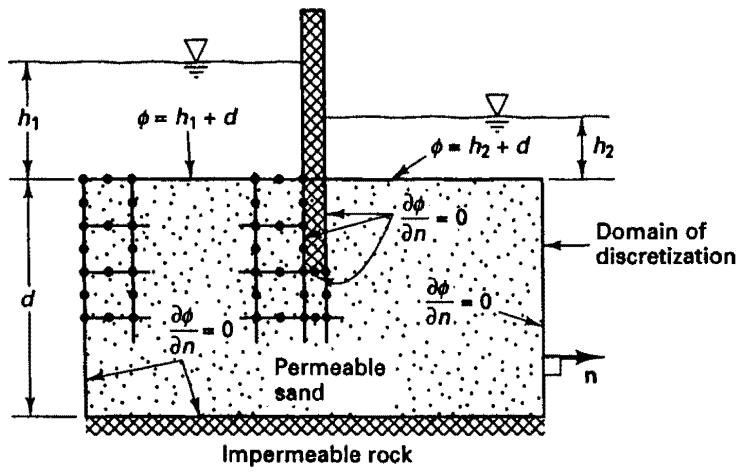
text_image h₁ φ = h₁ + d φ = h₂ + d h₂ d ∂φ/∂n = 0 ∂φ/∂n = 0 Permeable sand Impermeable rock Domain of discretization n
Figure 7.2 Analysis of seepage conditions under a dam heat transfer conditions considered in Section 7.2 and the seepage conditions considered here. Figure 7.2 illustrates a finite element analysis of a seepage problem. # 7.3.2 Incompressible Inviscid Flow Consider an incompressible fluid in irrotational two-dimensional flow conditions. In this case the vorticity vanishes, so that (see, for example, F. M. White [A]) $$ \frac {\partial v _ {x}}{\partial y} - \frac {\partial v _ {y}}{\partial x} = 0 \tag {7.41} $$ where $v_{x}$ and $v_{y}$ are the fluid velocities in the x and y directions, respectively. The continuity condition is given by $$ \frac {\partial v _ {x}}{\partial x} + \frac {\partial v _ {y}}{\partial y} = 0 \tag {7.42} $$ To solve (7.41) and (7.42) we define a potential function $\phi(x, y)$ such that $$ v _ {x} = \frac {\partial \phi}{\partial x}; \quad v _ {y} = \frac {\partial \phi}{\partial y} \tag {7.43} $$ The relation in (7.41) is then identically satisfied, and (7.42) reduces to $$ \frac {\partial^ {2} \phi}{\partial x ^ {2}} + \frac {\partial^ {2} \phi}{\partial y ^ {2}} = 0 \tag {7.44} $$ Using (7.43), we impose all boundary normal velocities, $v_{n}^{s}$ using $$ \left. \frac {\partial \phi}{\partial n} \right| _ {s} = v _ {n} ^ {s} \tag {7.45} $$ where $\partial \phi / \partial n$ denotes the derivative of $\phi$ in the direction of the unit normal vector (pointing outward) to the boundary. In addition, we need to prescribe an arbitrary value $\phi$ at an