| SUBROUTINE STIFBL | STBL | 1 |
| C********** | ********** | STBL | 2 |
| C | | STBL | 3 |
| C *** CALCULATES ELEMENT STIFFNESS MATRICES | | STBL | 4 |
| C | | STBL | 5 |
| C********** | ********** | STBL | 6 |
| COMMON/UNIM1/NPOIN,NELEM,NBOUN,NLAYR,NPROP,NNODE,IINCS,IITER, | STBL | 7 |
| KRESL,NCHEK,TOLER,NALGO,NSVAB,NDOFN,NINCS,NEVAB, | STBL | 8 |
| NITER,NOUTP,FACTO | STBL | 9 |
| COMMON/UNIM2/PROPS(5,25),COORD(26),LNODS(25,2),IFPRE(52), | STBL | 10 |
| FIXED(52),TLOAD(25,4),RLOAD(25,4),ELOAD(25,4), | STBL | 11 |
| MATNO(25),STRES(25,2),PLAST(250),XDISP(52), | STBL | 12 |
| TDISP(26,2),TREAC(26,2),ASTIF(52,52),ASLOD(52), | STBL | 13 |
| REACT(52),FRESV(1352),PEFIX(52),ESTIF(4,4), | STBL | 14 |
| STRSL(250,2) | STBL | 15 |
| REWIND 1 | STBL | 16 |
| DO 20 IELEM=1,NELEM | STBL | 17 |
| LPROP=MATNO(IELEM) | STBL | 18 |
| CALL LAYER(IELEM,EIVAL,SVALU) | STBL | 19 |
| HARDS=PROPS(LPROP,4) | STBL | 20 |
| NODE1=LNODS(IELEM,1) | STBL | 21 |
| NODE2=LNODS(IELEM,2) | STBL | 22 |
| ELENG=ABS(COORD(NODE2)-COORD(NODE1)) | STBL | 23 |
| VALU1=0.5*SVALU | STBL | 24 |
| VALU2=SVALU/ELENG | STBL | 25 |
| VALU3=EIVAL/ELENG | STBL | 26 |
| VALU4=0.25*SVALU*ELENG | STBL | 27 |
| ESTIF(1,1)=VALU2 | STBL | 28 |
| ESTIF(1,2)=VALU1 | STBL | 29 |
| ESTIF(1,3)=-VALU2 | STBL | 30 |
| ESTIF(1,4)=VALU1 | STBL | 31 |
| ESTIF(2,2)=VALU3+VALU4 | STBL | 32 |
| ESTIF(2,3)=-VALU1 | STBL | 33 |
| ESTIF(2,4)=-VALU3+VALU4 | STBL | 34 |
| ESTIF(3,3)=VALU2 | STBL | 35 |
| ESTIF(3,4)=-VALU1 | STBL | 36 |
| ESTIF(4,4)=VALU3+VALU4 | STBL | 37 |
| DO 10 ISTIF=1,4 | STBL | 38 |
| DO 10 JSTIF=ISTIF,4 | STBL | 39 |
| 10 | ESTIF(JSTIF,ISTIF)=ESTIF(ISTIF,JSTIF) | STBL | 40 |
| WRITE(1) ESTIF | STBL | 41 |
| 20 | CONTINUE | STBL | 42 |
| RETURN | STBL | 43 |
| END | STBL | 44 |
STBL 19 Call routine LAYER which evaluates approximate values of EI and exact values of $GA$ using a mid-ordinate rule. Note that certain layers may be plastic.
Subroutine RFORBL This routine evaluates p for the layered beam using the mid-ordinate rule.
| SUBROUTINE RFORBL | RFRL | 1 |
| C********** | RFRL | 2 |
| C | RFRL | 3 |
| C *** CALCULATES INTERNAL EQUIVALENT NODAL FORCES | RFRL | 4 |
| C | RFRL | 5 |
| C********** | RFRL | 6 |
| COMMON/UNIM1/NPOIN,NELEM,NBOUN,NLAYR,NPROP,NNODE,IINCS,IITER, | RFRL | 7 |
| KRESL,NCHEK,TOLER,NALGO,NSVAB,NDOFN,NINCS,NEVAB, | RFRL | 8 |
| NITER,NOUTP,FACTO | RFRL | 9 |
| COMMON/UNIM2/PROPS(5,25),COORD(26),LNODS(25,2),IFPRE(52), | RFRL | 10 |
| FIXED(52),TLOAD(25,4),RLOAD(25,4),ELOAD(25,4), | RFRL | 11 |
| MATNO(25),STRES(25,2),PLAST(250),XDISP(52), | RFRL | 12 |
| TDISP(26,2),TREAC(26,2),ASTIF(52,52),ASLOD(52), | RFRL | 13 |
| REACT(52),FRESV(1352),PEFIX(52),ESTIF(4,4), | RFRL | 14 |
| STRSL(250,2) | RFRL | 15 |
| DIMENSION STRAN(2) | RFRL | 16 |
| DO 15 IELEM=1,NELEM | RFRL | 17 |
| DO 10 IEVAB=1,NEVAB | RFRL | 18 |
| 10 ELOAD(IELEM,IEVAB)=0.0 | RFRL | 19 |
| DO 15 IDOFN=1,NDOFN | RFRL | 20 |
| 15 STRES(IELEM,IDOFN)=0.0 | RFRL | 21 |
| KLAYR=0 | RFRL | 22 |
| DO 70 IELEM=1,NELEM | RFRL | 23 |
| LPROP=MATNO(IELEM) | RFRL | 24 |
| YOUNG=PROPS(LPROP,1) | RFRL | 25 |
| SHEAR=PROPS(LPROP,2) | RFRL | 26 |
| YIELD=PROPS(LPROP,3) | RFRL | 27 |
| HARDS=PROPS(LPROP,4) | RFRL | 28 |
| THKTO=PROPS(LPROP,5) | RFRL | 29 |
| NODE1=LNODS(IELEM,1) | RFRL | 30 |
| NODE2=LNODS(IELEM,2) | RFRL | 31 |
| ELENG=ABS(COORD(NODE2)-COORD(NODE1)) | RFRL | 32 |
| WNOD1=XDISP(NODE1*NDOFN-1) | RFRL | 33 |
| WNOD2=XDISP(NODE2*NDOFN-1) | RFRL | 34 |
| THTA1=XDISP(NODE1*NDOFN) | RFRL | 35 |
| THTA2=XDISP(NODE2*NDOFN) | RFRL | 36 |
| STRAN(1)=(THTA1-THTA2)/ELENG | RFRL | 37 |
| STRAN(2)=(WNOD2-WNOD1)/ELENG | RFRL | 38 |
| -0.5*(THTA1+THTA2) | RFRL | 39 |
| ZMIDL=-THKTO/2.0 | RFRL | 40 |
| KOUNT=5 | RFRL | 41 |
| DO 50 ILAYR=1,NLAYR | RFRL | 42 |
| KLAYR=KLAYR+1 | RFRL | 43 |
| KOUNT=KOUNT+1 | RFRL | 44 |
| BRDTH=PROPS(LPROP,KOUNT) | RFRL | 45 |
| KOUNT=KOUNT+1 | RFRL | 46 |
| THICK=PROPS(LPROP,KOUNT) | RFRL | 47 |
| ZMIDL=ZMIDL+THICK/2.0 | RFRL | 48 |
| STLIN=YOUNG*STRAN(1)*ZMIDL | RFRL | 49 |
| STCUR=STRSL(KLAYR,1)+STLIN | RFRL | 50 |
| PREYS=YIELD+HARDS*ABS(PLAST(KLAYR)) | RFRL | 51 |
| IF(ABS(STRSL(KLAYR,1)).GE.PREYS) GO TO 20 | RFRL | 52 |
| ESCUR=ABS(STCUR)-PREYS | RFRL | 53 |
| IF(ESCUR.LE.0.0) GO TO 40 | RFRL | 54 |
```csv
RFACT=ESCUR/ABS(STLIN) RFRL 55
GO TO 30 RFRL 56
20 IF(STRSL(KLAYR,1).GT.0.0.AND.STLIN.LE.0.0) GO TO 40 RFRL 57
IF(STRSL(KLAYR,1).LT.0.0.AND.STLIN.GE.0.0) GO TO 40 RFRL 58
RFACT=1.0 RFRL 59
30 REDUC=1.0-RFACT RFRL 60
STRSL(KLAYR,1)=STRSL(KLAYR,1)+REDUC*STLIN+ RFRL 61
• RFACT*YOUNG*(1.0-YOUNG/(YOUNG+HARDS))*STRAN(1)*ZMIDL RFRL 62
PLAST(KLAYR)=PLAST(KLAYR)+RFACT*STRAN(1)*YOUNG/(YOUNG+HARDS) RFRL 63
.*ZMIDL RFRL 64
GO TO 45 RFRL 65
40 STRSL(KLAYR,1)=STRSL(KLAYR,1)+STLIN RFRL 66
45 STRSL(KLAYR,2)=STRSL(KLAYR,2)+STRAN(2)*SHEAR RFRL 67
STRES(IELEM,1)=STRES(IELEM,1)+STRSL(KLAYR,1)* RFRL 68
• BRDTH*THICK*ZMIDL RFRL 69
STRES(IELEM,2)=STRES(IELEM,2)+STRSL(KLAYR,2)* RFRL 70
• BRDTH*THICK RFRL 71
ZMIDL=ZMIDL+THICK/2.0 RFRL 72
50 CONTINUE RFRL 73
ELOAD(IELEM,1)=ELOAD(IELEM,1)-STRES(IELEM,2) RFRL 74
ELOAD(IELEM,2)=ELOAD(IELEM,2)+STRES(IELEM,1) RFRL 75
• -0.5*ELENG*STRES(IELEM,2) RFRL 76
ELOAD(IELEM,3)=ELOAD(IELEM,3)+STRES(IELEM,2) RFRL 77
ELOAD(IELEM,4)=ELOAD(IELEM,4)-STRES(IELEM,1) RFRL 78
• -0.5*ELENG*STRES(IELEM,2) RFRL 79
70 CONTINUE RFRL 80
RETURN RFRL 81
END RFRL 82
```
Subroutine LAYER This routine evaluates EI and $GA\hat{A}$ using the mid-ordinate rule. Note that certain layers may be plastic and therefore have a modified E.
```txt
SUBROUTINE LAYER(IELEM,EIVAL,SVALU) LAYR 1
C******************************************************************************************
C LAYR 2
C LAYR 3
C *** CALCULATES INTEGRATED VALUES FOR EI AND GA THROUGH DEPTH LAYR 4
C LAYR 5
C******************************************************************************************
COMMON/UNIM1/NPOIN,NELEM,NBOUN,NLAYR,NPROP,NNODE,IINCS,IITER, LAYR 7
. KRESL,NCHEK,TOLER,NALGO,NSVAB,NDOFN,NINCS,NEVAB, LAYR 8
. NITER,NOUTP,FACTO LAYR 9
COMMON/UNIM2/PROPS(5,25),COORD(26),LNODS(25,2),IFPRE(52), LAYR 10
. FIXED(52),TLOAD(25,4),RLOAD(25,4),ELOAD(25,4), LAYR 11
. MATNO(25),STRES(25,2),PLAST(250),XDISP(52), LAYR 12
. TDISP(26,2),TREAC(26,2),ASTIF(52,52),ASLOD(52), LAYR 13
. REACT(52),FRESV(1352),PEFIX(52),ESTIF(4,4), LAYR 14
. STRSL(250,2) LAYR 15
EIVAL=0.0 LAYR 16
SVALU=0.0 LAYR 17
LPROP=MATNO(IELEM) LAYR 18
KLAYR=(IELEM-1)*NLAYR LAYR 19
SHEAR=PROPS(LPROP,2) LAYR 20
HARDS=PROPS(LPROP,4) LAYR 21
THKTO=PROPS(LPROP,5) LAYR 22
ZMIDL=-THKTO/2.0 LAYR 23
KOUNT=5 LAYR 24
DO 10 ILAYR=1,NLAYR LAYR 25
KLAYR=KLAYR+1 LAYR 26
YOUNG=PROPS(LPROP,1) LAYR 27
IF(PLAST(KLAYR).NE.0.0) YOUNG=YOUNG*(1.0-YOUNG/(YOUNG+HARDS)) LAYR 28
```
KOUNT=KOUNT+1 LAYR 29
BRDTH=PROPS(LPROP,KOUNT) LAYR 30
KOUNT=KOUNT+1 LAYR 31
THICK=PROPS(LPROP,KOUNT) LAYR 32
ZMIDL=ZMIDL+THICK/2.0 LAYR 33
EIVAL=EIVAL+YOUNG*BRDTH*THICK*ZMIDL*ZMIDL LAYR 34
SVALU=SVALU+SHEAR*BRDTH*THICK LAYR 35
ZMIDL=ZMIDL+THICK/2.0 LAYR 36
10 CONTINUE LAYR 37
RETURN LAYR 38
END LAYR 39
# 5.5.6 Examples of layered elasto-plastic Timoshenko beam analysis
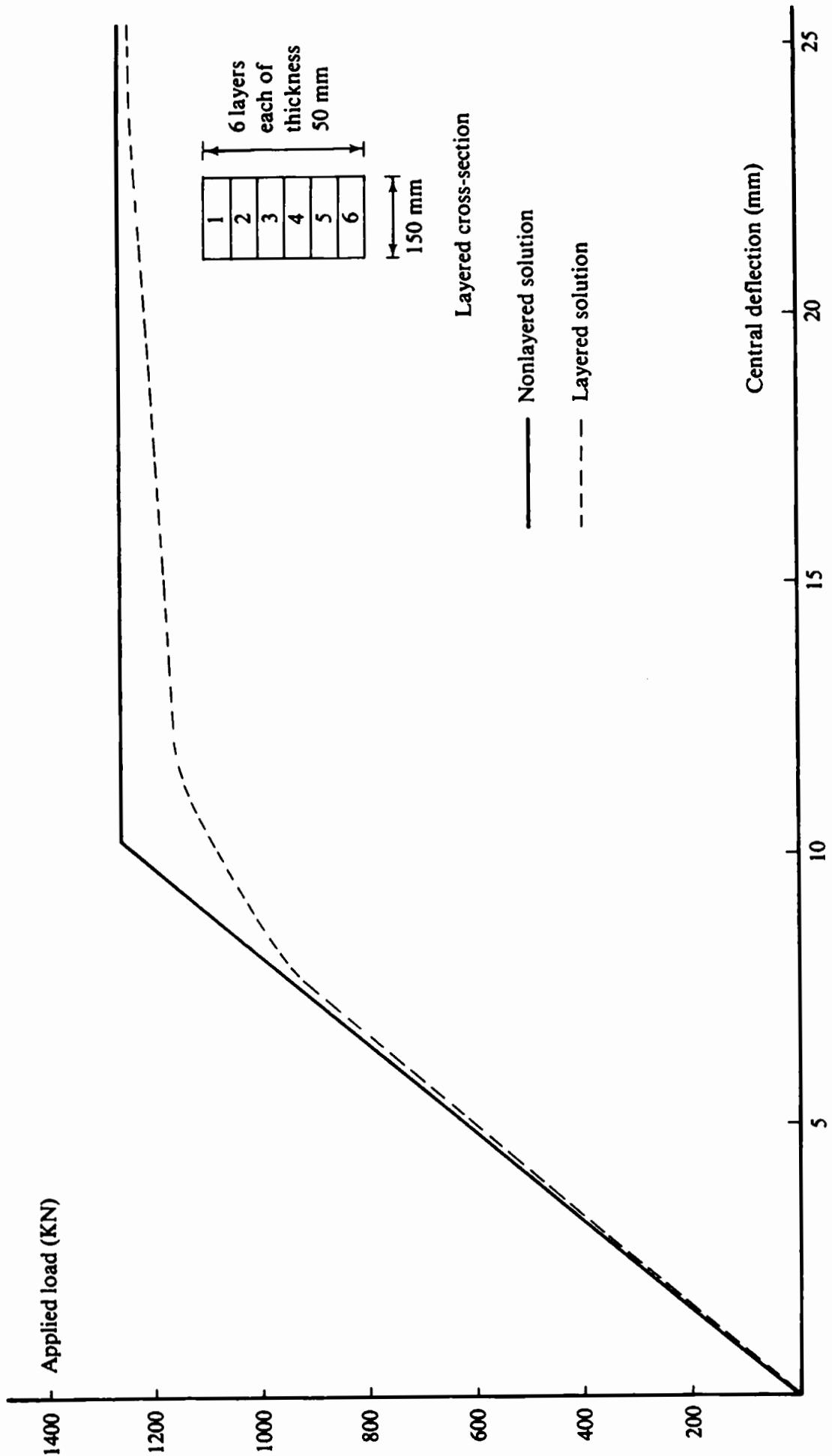
The third example considered in this chapter is the elasto-plastic analysis of the simple beam of Example 5.1. The layered solution is adopted in this case. A typical input data listing is provided in Appendix IV.
The results for both nonlayered and layered solutions to this beam problem are reproduced in Fig. 5.10.
The last example to be considered here is the layered solution of the clamped I-beam given in Example 5.1.
Again, both nonlayered and layered solution results are illustrated in Fig. 5.11.
From Figs. 5.10 and 5.11 it is obvious that the layered solution is more realistic. Yielding takes place gradually through the layers, resulting in smoother curves representing the load-displacement relationship.
# 5.6 Problems
5.1 Derive the main expressions for the elasto-plastic analysis of Timoshenko beams using elements with
(i) Quadratic shape functions
$$
N _ {1} ^ {(e)} = \frac {(x ^ {(e)} - x _ {2} ^ {(e)}) (x ^ {(e)} - x _ {3} ^ {(e)})}{(x _ {1} ^ {(e)} - x _ {2} ^ {(e)}) (x _ {1} ^ {(e)} - x _ {3} ^ {(e)})}
$$
$$
N _ {2} ^ {(e)} = \frac {\big (x ^ {(e)} - x _ {1} ^ {(e)} \big) \big (x ^ {(e)} - x _ {3} ^ {(e)} \big)}{\big (x _ {2} ^ {(e)} - x _ {1} ^ {(e)} \big) \big (x _ {2} ^ {(e)} - x _ {3} ^ {(e)} \big)}
$$
$$
N _ {3} ^ {(e)} = \frac {\left(x ^ {(e)} - x _ {1} ^ {(e)}\right) \left(x ^ {(e)} - x _ {2} ^ {(e)}\right)}{\left(x _ {3} ^ {(e)} - x _ {1} ^ {(e)}\right) \left(x _ {3} ^ {(e)} - x _ {2} ^ {(e)}\right)} \tag {5.58}
$$