| Echoes the remaining data after input data errors have been diagnosed. |
| EXPLIT | Section 10.6.5 (DYNPAK)Carries out explicit time integration. |
| FEAM | Section 9.6.2 (MINDLAY)Organising routine for the elasto-plastic analysis of layered Mindlin plates. |
| FEMP | Section 9.5.2 (MINDLIN)Organising routine for the elasto-plastic analysis of nonlayered Mindlin plates. |
| FIXITY | Section 10.6.6 (DYNPAK)Boundary conditions are inserted. |
| FLOWMP | Section 9.5.5 (MINDLIN, MINDLAY)Determines $\partial F/\partial \sigma_{f}$ (i.e. yield function derivatives) for elastoplastic layered and nonlayered Mindlin plates. |
| FLOWPL | Section 7.8.4.2 (PLANET, MIXDYN)Determines the vector $d_{D}$ for elasto-plastic analysis. |
| FLOWVP | Section 8.9 (VISCOUNT, DYNPAK)Determines the viscoplastic strain rate for each Gauss point according to (8.7). |
| FRONT | Section 6.4.12 (PLANET, VISCOUNT, MINDLIN, MINDLAY)Performs element assembly and equation solution by the frontal method. Contains a facility for efficient resolution of equations. |
| FUNCTA | Section 10.6.8 (DYNPAK, MIXDYN)Interpolates acceleration ordinate at $\Delta t$ intervals. |
| FUNCTS | Section 10.6.9 (DYNPAK, MIXDYN)Evaluates factor for Heaviside and Harmonic time function at $\Delta t$ apart. |
| GAUSSQ | Section 6.4.2 (PLANET, VISCOUNT, MINDLIN, MINDLAY, DYNPAK, MIXDYN)Evaluates the sampling point positions and weighing factors for numerical integration by Gauss quadrature. |
| GEOMST | Section 11.5.8 (MIXDYN)Evaluates the stress stiffness matrix. |
| GRADMP | Section 9.5.6 (MINDLIN)Evaluates the total displacement and rotation derivatives ( $\partial w/\partial x$ , $\partial w/\partial y$ , $\partial \theta_{x}/\partial x$ , $\partial \theta_{x}/\partial y$ , $\partial \theta_{y}/\partial x$ , $\partial \theta_{y}/\partial y$ ). |
| GSTIFF | Section 11.5.9 (MIXDYN)Evaluates the global stiffness matrix in compacted profile form. |
| IMPEXP | Section 11.5.10 (MIXDYN)Sets the constants of integration and evaluates partial effective load vector. |
| INCREM | Section 6.5.3 (PLANET, VISCOUNT, MINDLIN, MINDLAY)Controls the incrementing of the applied loads for two-dimensional applications. |
| INPUT | Section 6.5.1 (PLANET, VISCOUNT, MINDLIN, MINDLAY)Data input subroutine for two-dimensional applications. |
| INPUTD | Section 10.6.10 (DYNPAK, MIXDYN)Data input subroutine. Reads the mesh data, properties etc |
| INTIME | Section 10.6.11 (DYNPAK, MIXDYN)Reads the data necessary for time integration. |
| INVAR | Section 7.8.3 (PLANET, VISCOUNT, DYNPAK, MIXDYN)Evaluates the effective stress level at a given point for monitoring plastic yielding. |
| INVERT | Section 8.7.3 (VISCOUNT)This subroutine determines the inverse of any arbitrary square matrix. |
| INVMP | Section 9.5.7 (MINDLIN)Evaluates the Mindlin plate stress resultant invariants for nonlayered plates. |
| ITRATE | Section 11.5.11 (MIXDYN)Evaluates the total effective load and iterates until convergence is reached. |
| JACOBD | Section 10.6.13 (DYNPAK, MIXDYN)Evaluates the deformation Jacobian matrix. |
| JACOB2 | Section 6.4.4 (PLANET, VISCOUNT, MINDLIN, MINDLAY, DYNPAK, MIXDYN)Evaluates the Jacobian matrix, its inverse and the Cartesian derivatives of the element shape functions for two-dimensional applications. |
| LAYMPA | Section 9.6.5 (MINDLAY)Evaluates the matrix of flexural rigidities and the matrix of shear rigidities for the layered elastoplastic Mindlin plate. |
| LINEAR | Section 7.8.6 (PLANET, MIXDYN)Determines the stresses from given displacements assuming linear elastic behaviour. |
| LINGNL | Section 10.6.14 (DYNPAK, MIXDYN)Evaluates the linear stresses for small and large deformation analysis. |
| LINKIN | Section 11.5.12 (MIXDYN)This routine links with the profile solver. |
| LOADPB | Section 6.4.6 (MINDLIN, MINDLAY)Evaluates the consistent nodal forces for plate bending problems. |
| LOADPL | Section 10.6.15 (DYNPAK, MIXDYN)Generates the load vector. |
| LOADPS | Section 6.4.5 (PLANET, VISCOUNT)Evaluates the consistent nodal forces due to gravity and distributed edge loads for two-dimensional problems. |
| LUMASS | Section 10.6.16 (DYNPAK, MIXDYN)Generates the consistent mass matrix for implicit elements and special lumped mass matrix for explicit elements. |
| MDMPA | Section 9.6.6 (MINDLAY)Evaluates the constitutive matrices for use in layered Mindlin plate analysis. |
| MINDPB | Section 9.5.8 (MINDLIN, MINDLAY)Reads additional input data for elasto-plastic, layered and nonlayered Mindlin plates. |
| MIXDYN | Section 11.5.2 (MIXDYN)Organises implicit/explicit transient dynamic program. |
| MODPB | Section 6.4.10 (MINDLIN)Evaluates the D matrix for plate bending applications. |
| MODPS | Section 6.4.9 (PLANET, VISCOUNT, DYNPAK, MIXDYN)Evaluates the D matrix for plane and axisymmetric situations. |
| MULTPY | Section 11.5.13 (MIXDYN)Multiplies square matrix to a vector or vector to a vector. |
| NODEXY | Section 6.4.1 (PLANET, VISCOUNT, MINDLIN, MINDLAY)Interpolates the coordinates of midside nodes for elements with straight sides. This routine is modified in MINDLIN and MINDLAY where a hierarchical formulation is adopted for the ninth node. (See Section 9.5). |
| NODXYR | Section 10.6.18 (DYNPAK, MIXDYN)Evaluates the midside node of elements. In case of axisymmetric problems if (R, Θ) coordinates are read r, z coordinates are evaluated within it. |
| OUTDYN | Section 10.6.19 (DYNPAK, MIXDYN)Writes the output on output file and stress and displacement histories of required Gauss points and nodes respectively on specified tapes. |
| OUTMP | Section 9.5.10 (MINDLIN)Outputs displacements, reactions and Gauss point stress resultants for elasto-plastic nonlayered Mindlin plates. |
| OUTMPA | Section 9.6.7 (MINDLAY)Outputs displacements, reactions and Gauss point layer stresses for elasto-plastic layered Mindlin plates. |
| OUTPUT | Section 7.8.8 (PLANET, VISCOUNT)Outputs the results for two-dimensional problems at specified intervals. |
| PLAST | Section 7.8.9 (PLANET)The main or master segment for two-dimensional elastoplastic applications. |
| PREVOS | Section 10.6.20 (DYNPAK, MIXDYN)Reads the initial force and stresses. |
| REDBAK | Section 11.5.14 (MIXDYN)Solves equations after matrix decomposition, using forward and backward substitution. |
| RESEPL | Section 11.5.15 (MIXDYN)Evaluates the internal force for different yield criteria in the implicit explicit program. |
| RESMP | Section 9.5.11 (MINDLIN)Evaluates the internal nodal forces |
$$
\boldsymbol {p} = \int_ {\Omega} \boldsymbol {B} _ {f} ^ {T} \sigma_ {f} d \Omega + \int_ {\Omega} \boldsymbol {B} _ {s} ^ {T} \sigma_ {s} d \Omega
$$
for the stress resultants $\sigma_{f}$ and $\sigma_{s}$ for elasto-plastic, non-layered Mindlin plates.
| Evaluates the stiffness matrix for each element for elastoplastic problems employing either D or $D_{ep}$ as appropriate. |
| STIFMP | Section 9.5.13 (MINDLIN) |
| Evaluates the stiffness matrices for nonlayered elastoplastic Mindlin plate elements. |
| STIFVP | Section 8.7.1 (VISCOUNT) |
| Evaluates the stiffness matrix for each element in turn for two-dimensional elastoplastic applications. |
| STIMPA | Section 9.6.9 (MINDLAY) |
| Evaluates the stiffness matrices for layered elastoplastic Mindlin plate elements. |
| STRESS | Section 8.10 (VISCOUNT) |
| Evaluates the increment in stress occurring during a timestep of a viscoplastic analysis according to (8.20). |
| STRMP | Section 9.5.14 (MINDLIN) |
| Evaluates stress resultants $[M_x, My, M_{xy}, Q_x, Q_y]^T$ for elastoplastic nonlayered Mindlin plates. |
| STRMPA | Section 9.6.10 (MINDLAY) |
| Evaluates the stresses $[\sigma_x, \sigma_y, \tau_{xy}, \tau_{xz}, \tau_{yz}]^T$ for elastoplastic layered Mindlin plates at each layer and each Gauss point. |
| SUBMP | Section 9.5.15 (MINDLIN, MINDLAY) |
| Carries out matrix multiplications in elastoplastic layered and nonlayered Mindlin plates. |
| TANGVP | Section 8.7.2 (VISCOUNT) |
| Evaluates the $D^n$ matrix for viscoplastic analysis by implicit time stepping schemes. |
| VISCO | Section 8.13 (VISCOUNT) |
| The main or master segment for two-dimensional elastopiscoplastic applications. |
| VZERO | Section 9.5.16 (MINDLIN, MINDLAY) |
| Zeroes a vector in elastoplastic layered and nonlayered Mindlin plates. |
| YIELDF | Section 7.8.4.1 (PLANET, VISCOUNT, MIXDYN, DYN-PAK) |
| Determines the flow vector a for plastic and viscoplastic applications. (Amended in Section 10.6.22 for dynamic transient problems). |
| ZERO | Section 7.8.2 (PLANET, VISCOUNT) |
| Sets to zero the contents of several arrays employed in the programs. (Modified for viscoplastic applications in Section 8.11). |
| ZEROMP | Section 9.5.16 (MINDLIN, MINDLAY) |
| Zeroes various arrays in elastoplastic layered and nonlayered Mindlin plate programs. |
# 12.3 Alternative material models
The plastic behaviour of most solids is adequately described by the four yield criteria presented in Chapter 7; namely the Tresca, Von Mises, Mohr-Coulomb and Drucker-Prager yield surfaces. However, for some engineering materials, notably concrete, rocks and soils, some modifications must be made to the above criteria or new yield surfaces postulated if an accurate prediction of the material response is required.
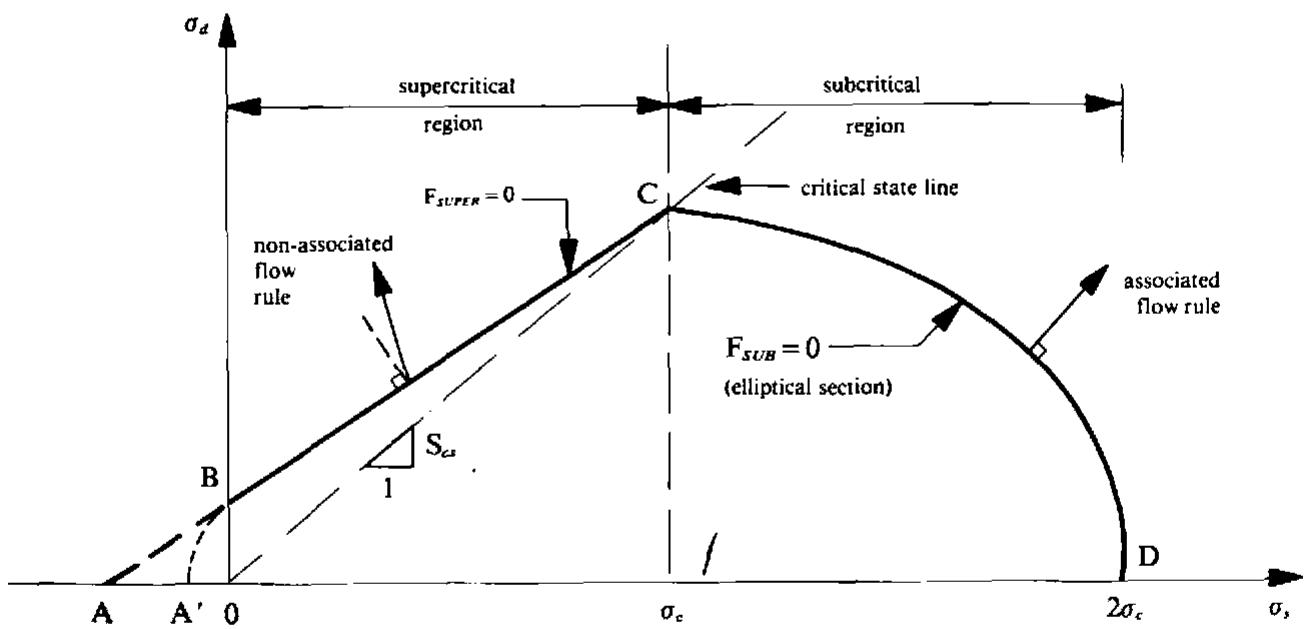
For soils, the Mohr–Coulomb and Drucker–Prager criteria suffer from two deficiencies. Firstly, the assumption of an associated flow rule leads to excessive dilatency and secondly it is seen from Fig. 7.4 that both models imply that the material can support an unlimited hydrostatic compression. These deficiencies can be removed by use of the so-called critical state model, which assumes that the yield surface comprises two distinct parts. $^{(1-3)}$ The surface is shown plotted in terms of deviatoric $\sigma_{d}$ and hydrostatic stress, $\sigma_{s}$ , in Fig. 12.1. In the subcritical region yielding is stable due to strain hardening of the material whilst the supercritical region exhibits strain softening so that this portion of the yield surface forms a failure criterion.